Harrison Clarke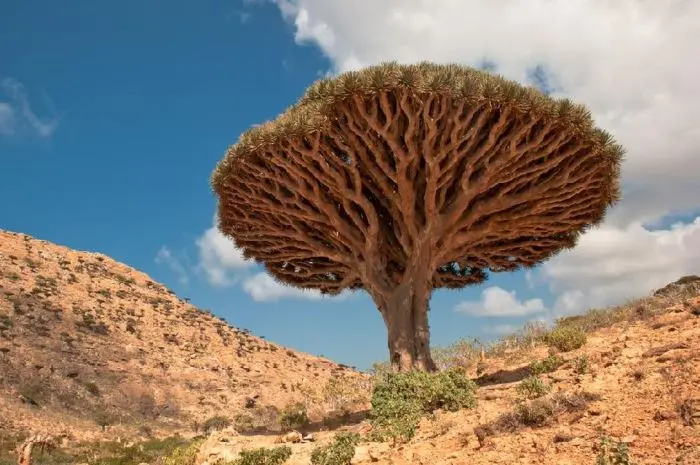
Yemen’s Socotra Island holds a variety of unique facts, from dragon’s blood trees to exotic flora and fauna, making it an unforgettable tourist destination.
Socotra Island, located off the southern coast of Yemen, is known as one of the most isolated and exotic places in the world. The island offers not only incredible natural beauty, but also a rich history and unique biodiversity.
Home to many endemic species, Socotra is often considered a “remote island” that holds many mysteries. From the iconic dragon’s blood tree to ancient archaeological sites, here are 10 fascinating facts about Socotra Island that make it worth exploring.
1. Dragon Blood Tree
One of the most prominent things when talking about Socotra Island is the presence of the Dragon Blood Tree (Dracaena cinnabari).
This tree is known for its unique shape, resembling a giant mushroom, with upward-pointing leaves and a large trunk. What’s more interesting, this tree produces a red sap known as “dragon’s blood”.
In ancient times, this sap was very valuable and was used as a base ingredient for paint, varnish, and medicines. Although its sap is no longer widely used for this purpose today, the tree remains an irreplaceable iconic symbol of the island.
The existence of the dragon’s blood tree, which only exists on Socotra, adds to the mysterious and enchanting impression of this island.
2. Inhabitants of Socotra Island
Socotra Island has a relatively small population, mostly of Indian, Somali and several other African ethnic groups.
The people of Socotra are renowned for their hospitality, making the island a comfortable if slightly isolated place to live. The lives of the Socotra people are largely dependent on livestock farming, fishing, and date palm cultivation.
Dates are one of the island’s main agricultural products, while many residents make a living by selling produce or engaging in the thriving ecotourism industry.
Although the island is rarely visited by international tourists, its inhabitants still maintain their rich traditions and simple but peaceful life.
3. Various Species of Flora and Fauna
Socotra Island is home to more than 800 plant species, about a third of which are endemic, meaning they can only be found on the island.
The flora of Socotra is extremely diverse, with some plants appearing quite exotic, such as the dragon’s blood tree and other desert plants.
The fauna of the island is also very interesting, with at least 34 species of reptiles, 96 species of land snails, and 192 species of birds. Many of these species are also endemic, adding to the island’s importance for biodiversity conservation.
Below the surface, Socotra also has a diverse marine life, including over 730 species of fish and 300 crustaceans, making it an attractive destination for ecotourism enthusiasts.
4. Origin of the Name Socotra
The name “Socotra” has been part of the history of the island.
There are several theories about the origin of the name, but many believe that the name comes from the Arabic word for “dragon’s blood market”, referring to the use of dragon’s blood tree sap in the past.
Others argue that the name Socotra comes from the Sanskrit word for “island of happiness”. The name describes the natural beauty of the island which can provide peace and tranquility to anyone who visits it.
As a place rich in history and culture, the name Socotra truly reflects the essence of this island full of natural wonders and mysteries.
5. Officially a UNESCO World Heritage Site
Socotra Island finally gains international recognition for its biodiversity value. In 2008, Socotra was recognized by UNESCO as a World Heritage Site, making it one of the globally recognized protected areas.
This status was given because of the island’s rich biodiversity and endemic species, which are severely threatened by environmental and human changes.
As a World Heritage Site, Socotra is now under greater protection, and conservation efforts are underway to ensure that its unique flora and fauna are preserved for future generations.
6. Ancient Trading Center
Although Socotra Island is now better known as an isolated place, in ancient times, it was an important trading center. Socotra was a meeting point for many great civilizations, including the Romans, Greeks, and Egyptians.
Traders from these regions came to Socotra to acquire exclusive goods such as frankincense and a red resin known as “ dragon’s blood.”
This resin was used for a variety of purposes, including as a natural dye, an ingredient in medicines, and even for religious purposes. This trading hub made Socotra a very important place in the past, although much of that history is now hidden.
7. Discovery of Ancient City
In 2010, Russian archaeologists discovered the ruins of an ancient city on the island of Socotra. The discovery shocked the archaeological world by showing that the island had a much richer history than previously thought.
These ruins include ancient caves and the remains of shipwrecks found around the coast. The discovery suggests that Socotra may have once been a thriving settlement, with trading activities involving multiple ancient civilizations.
This discovery further adds to the appeal of Socotra as a place full of mystery and archaeological potential that has not been fully explored.
8. Socotra Island Industry
Socotra has an industry that relies largely on agriculture and fishing. The community grows dates, which are an important commodity, as well as managing pearl harvests and fishing.
However, in recent years, the ecotourism industry has begun to grow rapidly on the island. With its extraordinary natural beauty and rich biodiversity, Socotra has attracted tourists from all over the world who want to explore the uniqueness of this island.
Activities such as diving, fishing, sailing and hiking are popular among tourists visiting the island, providing new economic opportunities for local residents.
9. Natural Beauty That Is Still Preserved
Socotra offers extraordinary natural scenery, from pristine white-sand beaches to dramatic hills and vast deserts.
This island has many places that have not been touched by humans, maintaining its authenticity which makes it one of the most beautiful islands in the world.
Socotra’s natural beauty is unique, with unique rock formations and vegetation that can only be found on this island. The stunning sunset views and underwater beauty make this island a perfect destination for nature lovers and photographers.
10. Accessibility Challenges
Although Socotra has many natural and cultural attractions, the island is relatively difficult to access.
There are only a few flights per week from Yemen and a few neighboring countries to Socotra, and transportation to the island relies mostly on boats or small planes.
The roads on the island are also sometimes difficult to navigate, making exploring Socotra a challenge.
However, it is precisely this difficulty in accessibility that makes Socotra a very exclusive and protected place from the tourist crowds, allowing visitors to enjoy the beauty of nature that is still pure and unpolluted.
Socotra Island is a place full of natural and cultural wonders that are still largely unknown to the world. From exotic dragon blood trees to unique wildlife, Socotra offers experiences that cannot be found anywhere else.
Its extraordinary biodiversity, ancient trading history, and stunning natural beauty make this island a truly worthwhile destination.
Despite its difficulty in reaching Easter Island, it remains attractive to those seeking adventure, tranquility and rare natural wonders.